




- 1.0What Is ASME B16.11?
- 2.0What Are the Pressure Classes in ASME B16.11?
- 3.0What Types of Fittings Are Covered by ASME B16.11?
- 4.0What Is the Relationship Between NPS and DN?
- 5.0How Are Reducing Fittings Dimensioned and Marked?
- 6.0What Are the Key Dimensions of Core ASME B16.11 Fittings? How Should They Be Referenced?
- 7.0Socket-Weld (SW) Coupling Dimensions
- 8.0Threaded (THD) Coupling Dimensions
- 9.090° Socket-Weld Elbow Dimensions (Class 3000)
- 10.0What Are the Tolerance Requirements in ASME B16.11? How Are They Controlled?
- 11.0What Material Requirements Does ASME B16.11 Specify?
- 12.0What Are the Marking Requirements for ASME B16.11 Fittings?
- 13.0What Is the Difference Between ASME B16.11 and ASME B16.9?
- 14.0What Are the Key Considerations When Using ASME B16.11 Fittings?
- 15.0ASME B16.11 Standard PDF Resources Download
- 16.0Frequently Asked Questions About ASME B16.11
- 17.0Summary
In industrial piping systems, the selection, installation, and compliance of forged pipe fittings directly affect system safety and operational stability. Among the applicable standards, ASME B16.11 is one of the most important specifications governing forged fittings used in piping systems. It is widely followed in industries such as chemical processing, food processing, and industrial cooling.
This article provides a structured overview of the ASME B16.11 standard, explaining its scope, pressure classifications, dimensional requirements, and typical applications to help readers understand the key technical aspects of the specification.
1.0What Is ASME B16.11?
ASME B16.11 is a standard developed by the American Society of Mechanical Engineers that specifies requirements for forged steel pipe fittings. The standard mainly covers two types of end connections: socket-weld (SW) fittings and threaded (THD) fittings.
The specification applies primarily to small-diameter piping systems with nominal pipe sizes ranging from NPS 1/8 to NPS 4, corresponding to DN 6 to DN 100.
The standard defines multiple technical requirements to ensure proper fitting performance in piping systems.
- Dimensions: Specifies the dimensional requirements for each fitting type to ensure compatibility with standard piping systems.
- Pressure-temperature ratings: Defines pressure classes and allowable operating limits depending on fitting design and connection type.
- Marking requirements: Establishes rules for marking fittings with manufacturer identification, material grade, pressure class, and size.
- Manufacturing tolerances: Provides dimensional tolerances to ensure consistent product quality.
- Material standards: References acceptable materials for forged fittings used in industrial service.
These requirements make ASME B16.11 an essential reference for ensuring reliability in low- and medium-pressure piping applications.
2.0What Are the Pressure Classes in ASME B16.11?
The pressure classifications in ASME B16.11 are determined by the connection type of the fitting. Threaded fittings and socket-weld fittings use different pressure class systems because their structural strength and sealing performance differ.
- Threaded fittings: Pressure classes include Class 2000, Class 3000, and Class 6000. These fittings are commonly used in moderate-pressure threaded piping systems.
- Socket-weld fittings: Pressure classes include Class 3000, Class 6000, and Class 9000. Due to the welded connection, socket-weld fittings generally provide higher pressure capability than threaded fittings.
- When selecting fittings according to ASME B16.11, several additional requirements should also be considered.
- Minimum pipe wall thickness: Table 7 of the standard specifies the corresponding pipe schedules for each fitting pressure class. The selected pipe must have a minimum wall thickness not less than the calculated value after deducting the 12.5% manufacturing tolerance.
- Reference to ASME B36.10M: If the pipe wall thickness is equal to or less than the thickness listed for the corresponding pipe schedule in ASME B36.10M, the fitting can be used under the designated pressure class.
- Special sizes: For pipe sizes NPS 1/8, 1/4, and 3/8, Schedule 160 or double-extra-strong wall thickness values are not included in ASME B36.10M. In such cases, the nominal wall thickness specified in Table 8 of ASME B16.11 should be used for classification.
The relationship between fitting pressure class and pipe wall thickness schedule is typically referenced as follows.
| Pressure Class | Fitting Type | Schedule | Wall Designation |
| 2000 | Threaded | 80 | XS |
| 3000 | Threaded | 160 | — |
| 6000 | Threaded | — | XXS |
| 3000 | Socket-weld | 80 | XS |
| 6000 | Socket-weld | 160 | — |
| 9000 | Socket-weld | — | XXS |
3.0What Types of Fittings Are Covered by ASME B16.11?
ASME B16.11 mainly applies to forged fittings used in small-diameter piping systems. The standard includes several common fitting types and provides detailed dimensional requirements for each.
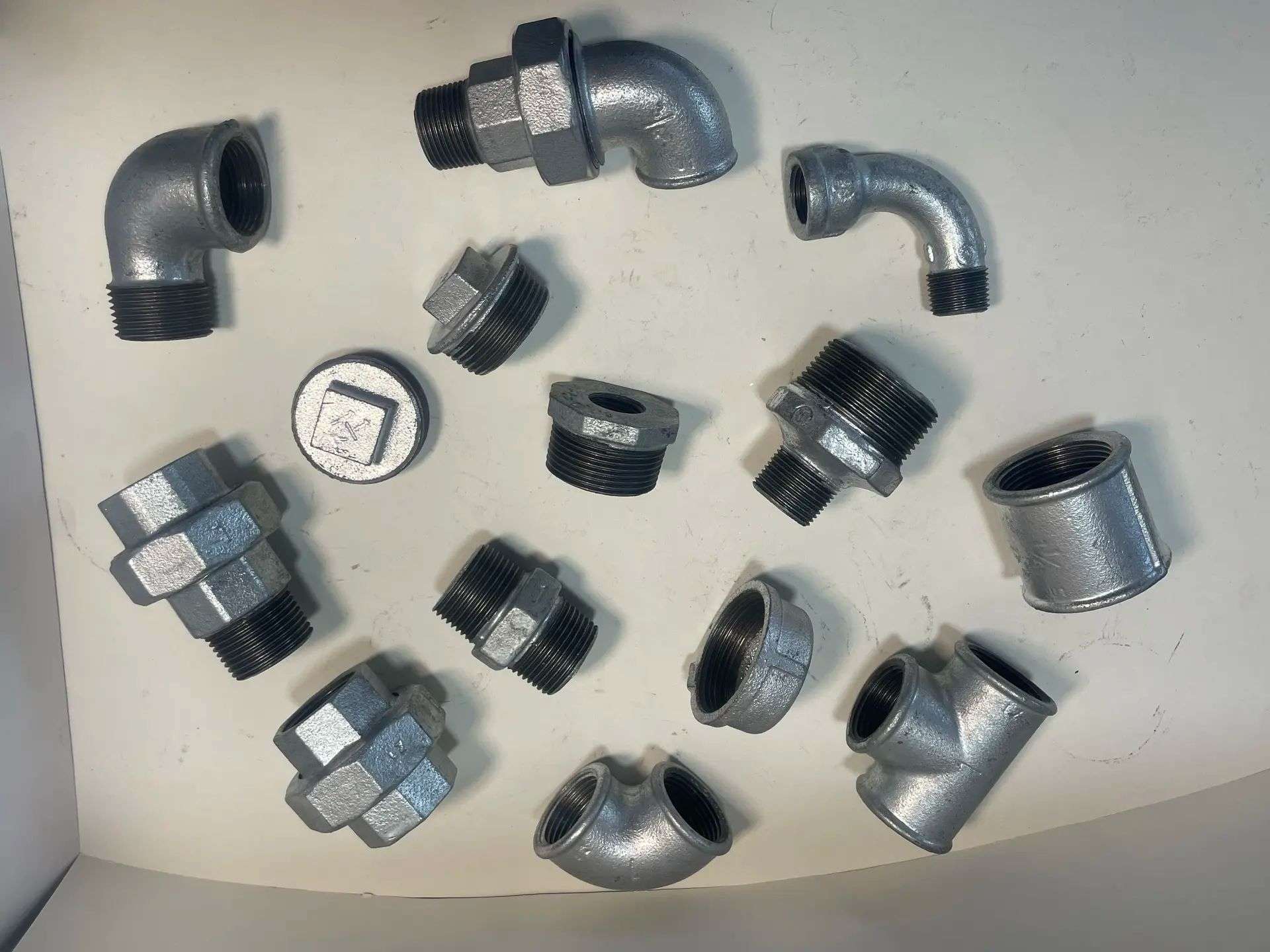
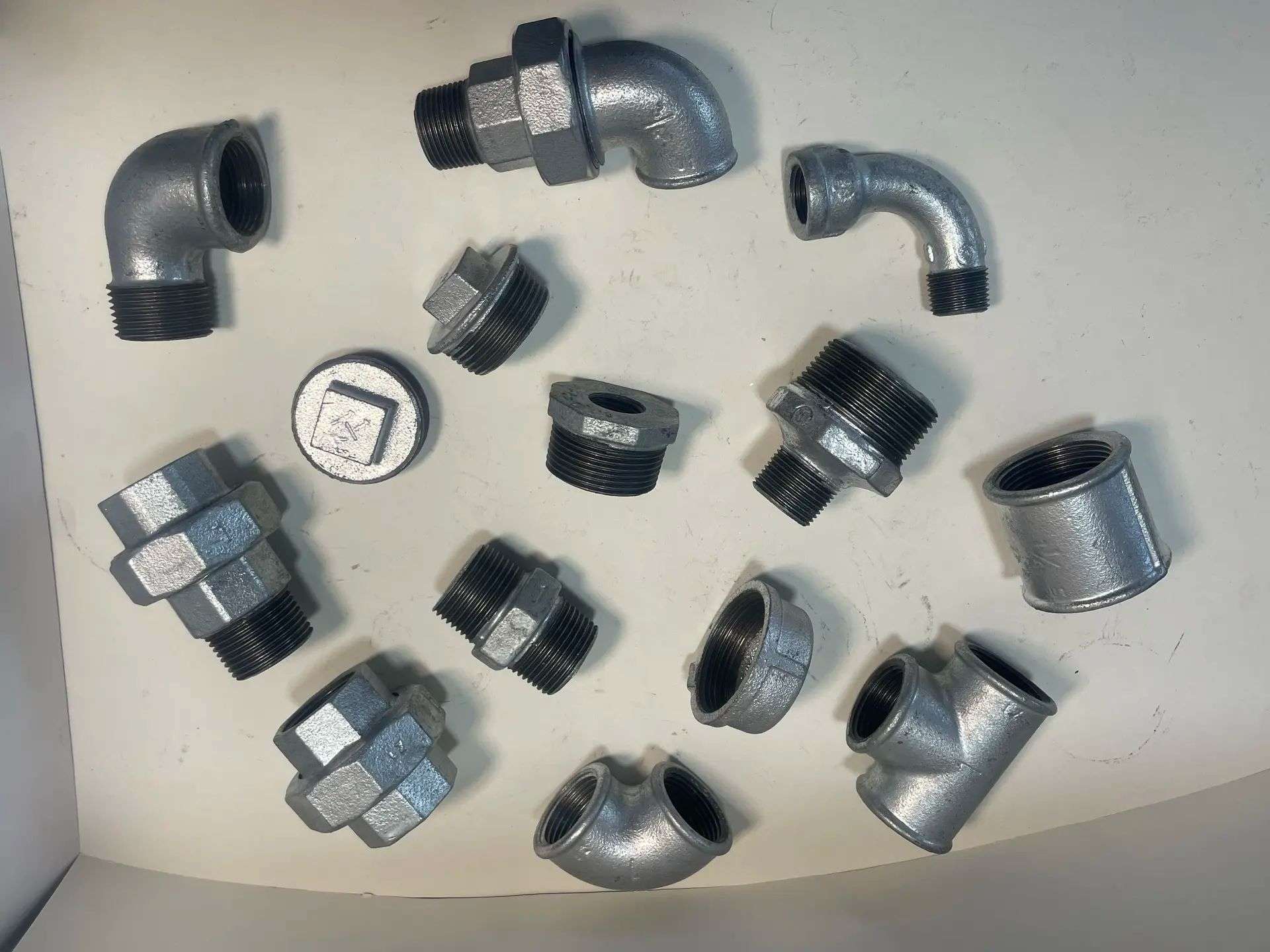
Typical fittings covered by the standard include elbows, tees, couplings, unions, caps, bushings, and plugs. Each fitting type has specified dimensions that ensure compatibility with standard pipe sizes and connection methods.
Understanding these dimensions is essential for proper piping design and installation.
4.0What Is the Relationship Between NPS and DN?
NPS (Nominal Pipe Size) is a dimensionless designation widely used in the United States piping system, while DN (Nominal Diameter) is the internationally used nominal diameter designation.
Although the two systems represent the same concept of nominal pipe size, they use different numbering conventions. Their correspondence is typically referenced using standard conversion tables.
| NPS | 1/8 | 1/4 | 3/8 | 1/2 | 3/4 | 1 | 1-1/4 | 1-1/2 | 2 | 2-1/2 | 3 | 4 |
| DN | 6 | 8 | 10 | 15 | 20 | 25 | 32 | 40 | 50 | 65 | 80 | 100 |
This conversion table helps engineers quickly identify equivalent sizes when working with different piping standards.
5.0How Are Reducing Fittings Dimensioned and Marked?
For reducing fittings such as reducing tees and reducing crosses, ASME B16.11 defines a standardized size designation method to avoid ambiguity during specification and installation.
- Reducing tee: The largest run opening is specified first, followed by the opposite run opening, and finally the branch opening. Example: NPS 2 × 1 × 1 indicates a 2-inch run with a 1-inch opposite end and a 1-inch branch.
- Reducing cross: The largest run opening is specified first, followed by the opposite run opening, then the larger side outlet, and finally the opposite outlet. Example: NPS 3 × 2 × 2 × 1 indicates a 3 × 2 inch run with side outlets of 2 and 1 inches.
This marking convention ensures consistent identification of reducing fittings in piping drawings, specifications, and procurement documentation.
6.0What Are the Key Dimensions of Core ASME B16.11 Fittings? How Should They Be Referenced?
ASME B16.11 covers a wide range of forged pipe fittings used in small-diameter piping systems. Common fitting types include 90° elbows, 45° elbows, tees, crosses, couplings, half couplings, caps, plugs, and bushings.
For practical engineering reference, the most frequently used fittings are summarized below with their key dimensional parameters (unit: mm). These dimensions can be used as a quick reference when designing or manufacturing fittings according to the ASME B16.11 standard.
7.0Socket-Weld (SW) Coupling Dimensions
Dimension notes:
- B: Socket bore diameter
- J: Socket depth
- C: Socket wall thickness (varies by pressure class)
7.1Basic Socket Dimensions
| NPS | B (Max) | B (Min) | J (Min) |
| 1/8 | 11.2 | 10.8 | 9.5 |
| 1/4 | 14.6 | 14.2 | 9.5 |
| 3/8 | 18.0 | 17.6 | 9.5 |
| 1/2 | 22.2 | 21.8 | 9.5 |
| 3/4 | 27.6 | 27.2 | 12.5 |
| 1 | 34.3 | 33.9 | 12.5 |
| 1-1/4 | 43.1 | 42.7 | 12.5 |
| 1-1/2 | 49.2 | 48.8 | 12.5 |
| 2 | 61.7 | 61.2 | 16.0 |
| 2-1/2 | 74.4 | 73.9 | 16.0 |
| 3 | 90.3 | 89.8 | 16.0 |
| 4 | 115.7 | 115.2 | 19.0 |
7.2Socket Wall Thickness (C) by Pressure Class
| NPS | 3000# C (Max) | 3000# C (Min) | 6000# C (Max) | 6000# C (Min) | 9000# C (Max) | 9000# C (Min) |
| 1/8 | 3.18 | 3.18 | 3.96 | 3.43 | — | — |
| 1/4 | 3.78 | 3.30 | 4.60 | 4.01 | — | — |
| 3/8 | 4.01 | 3.50 | 5.03 | 4.37 | — | — |
| 1/2 | 4.67 | 4.09 | 5.97 | 5.18 | 9.35 | 8.18 |
| 3/4 | 4.90 | 4.27 | 6.96 | 6.04 | 9.78 | 8.56 |
| 1 | 5.69 | 4.98 | 7.92 | 6.93 | 11.38 | 9.96 |
8.0Threaded (THD) Coupling Dimensions
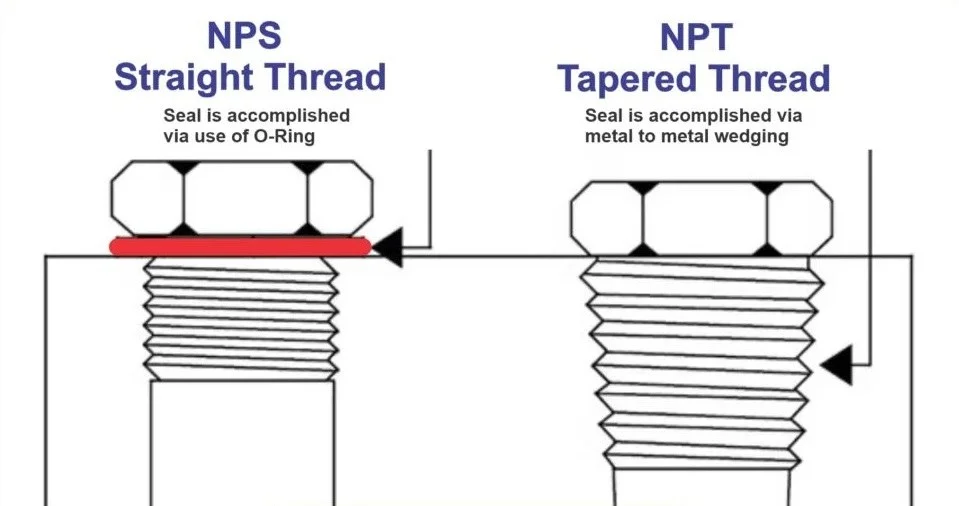
Threaded fittings in ASME B16.11 use taper pipe threads in accordance with the ASME B1.20.1 standard. Both internal and external threads are tapered, and sealing is typically achieved using PTFE tape or thread sealant during installation.
| NPS | B (Minimum Thread Length) | L2 (External Thread Effective Length) |
| 1/8 | 6.4 | 6.7 |
| 1/4 | 8.1 | 10.2 |
| 3/8 | 9.1 | 10.4 |
| 1/2 | 10.9 | 13.6 |
| 3/4 | 12.7 | 13.9 |
| 1 | 14.7 | 17.3 |
9.090° Socket-Weld Elbow Dimensions (Class 3000)
The 90-degree socket-weld elbow is one of the most widely used forged fittings in high-pressure small-diameter piping systems. The following table lists the key dimensions for Class 3000 socket-weld elbows.
| DN | NPS | B (Min) | C (Avg) | D (Avg) | J (Min) |
| 6 | 1/8 | 10.8 | 3.18 | 3.18 | 9.5 |
| 8 | 1/4 | 14.2 | 3.78 | 3.30 | 9.5 |
| 15 | 1/2 | 21.8 | 4.67 | 4.09 | 9.5 |
| 20 | 3/4 | 27.2 | 4.90 | 4.27 | 12.5 |
| 25 | 1 | 33.9 | 5.69 | 4.98 | 12.5 |
For other elbow types and additional dimensional parameters, the detailed tables in the ASME B16.11 specification should be referenced. These tables provide complete dimensional data for all fitting types and pressure classes covered by the standard.
10.0What Are the Tolerance Requirements in ASME B16.11? How Are They Controlled?
Dimensional tolerances play a critical role in ensuring proper fitting compatibility and operational safety in piping systems. ASME B16.11 specifies allowable tolerances for parameters such as wall thickness, bore concentricity, and alignment of axes. Controlling these tolerances during manufacturing helps ensure reliable installation and long-term system performance.
The main tolerance requirements are summarized below.
10.1Wall Thickness Tolerance
The minimum wall thickness of the selected pipe must consider manufacturing tolerances. After deducting the standard 12.5% wall thickness tolerance, the remaining thickness must not be less than the calculated minimum wall thickness required for the design condition.
This requirement ensures that the pipe and the corresponding fitting maintain sufficient pressure-containing capability in service.
10.2Bore Concentricity Tolerance
ASME B16.11 defines allowable limits for the concentricity of socket and fitting bores to maintain proper alignment during installation.
- Socket and fitting bore concentricity: The maximum allowable deviation is 0.8 mm (0.03 in) for all sizes.
- Opposite socket bore concentricity: The maximum allowable deviation between opposing socket bores is 1.5 mm (0.06 in).
Maintaining proper concentricity ensures accurate pipe insertion and helps prevent welding defects or mechanical misalignment.
10.3Axis Alignment Requirements
Alignment between connection bores is another important dimensional control specified in the standard.
- Socket and fitting bore axis alignment: Maximum permissible offset is 1 mm within 200 mm length (0.06 in per foot).
- Thread axis alignment: Maximum permissible offset is also 1 mm within 200 mm length (0.06 in per foot).
These alignment limits help ensure proper joint assembly and minimize installation stress within the piping system.
11.0What Material Requirements Does ASME B16.11 Specify?
Material selection is an important factor affecting the durability, pressure resistance, and corrosion performance of forged fittings. ASME B16.11 specifies both acceptable material forms and applicable material standards.
11.1Material Forms
Forged fittings must be manufactured from approved material forms to ensure adequate mechanical properties.
- Permitted material forms: Forgings, bar stock, seamless pipe, or seamless tubular products.
- Restriction: Materials that do not meet the required specifications are not permitted.
11.2Applicable Material Standards
The standard references several ASTM material specifications commonly used for forged fittings.
- Fitting material specifications: ASTM A234, ASTM A403, ASTM A420, ASTM A815, ASTM B366.
- Forging material specifications: ASTM A105, ASTM A182, ASTM A350, ASTM B462, ASTM B564.
These specifications define the mechanical properties, chemical composition, and heat treatment requirements for materials used in forged fittings.
11.3Manufacturing Restrictions
Certain fittings must follow specific manufacturing limitations.
Bar stock restriction: Tees, elbows, and crosses are not permitted to be manufactured from bar stock.
11.4Material Selection Guidelines
Material selection should be based on the service conditions of the piping system.
- Carbon steel: ASTM A105 and ASTM A350 LF2 are commonly used for general industrial service and moderate-pressure applications.
- Stainless steel: ASTM A182 F304 and F316 are widely used in corrosive environments or in industries such as food processing and chemical processing.
- Alloy steel: ASTM A182 F5, F11, and F22 are typically used for high-temperature or high-pressure applications.
Selecting the correct material according to the operating environment helps ensure both performance reliability and compliance with ASME B16.11 requirements.
12.0What Are the Marking Requirements for ASME B16.11 Fittings?
ASME B16.11 requires each forged fitting to be properly marked to ensure traceability, identification, and compliance verification. The standard specifies the location, required content, and omission rules for markings to maintain consistency across manufacturers.
12.1Marking Location
Markings must be placed in a visible and durable area of the fitting to ensure they remain identifiable after installation.
- General marking location: Each fitting shall be marked on the boss, collar, or raised portion of the forging using raised lettering, stamping, electro-etching, or vibro-engraving.
- Cylindrical fittings: Markings are typically applied on the outside diameter or at the end of the fitting to prevent removal or damage during welding or installation.
- Exceptions: Bushings and plugs are not required to be marked.
12.2Mandatory Marking Information
At minimum, the following five items must appear on each fitting.
- Manufacturer identification: The manufacturer’s name or registered trademark.
- Material identification: The material designation corresponding to the applicable ASTM specification.
- Product compliance identification:
- Fittings covered by Section 1.1.1: Marked with the ASTM material designation (such as “WP_____”) or with the designation “B16”.
- Fittings covered by Section 1.1.2: ASTM A234, A403, A420, and A815 fittings shall include the suffix “S58”; ASTM B366 fittings shall include the suffix “SPLD”; fittings produced according to ASTM forging specifications shall include the suffix “B16+SPLD”.
- Pressure class designation: Indicated as 2000, 3000, 6000, or 9000, or alternatively 2M, 3M, 6M, or 9M (where M represents 1000).
- Nominal size: The nominal pipe size corresponding to the end connection.
12.3Marking Omission Rules
If the size or shape of the fitting does not allow all required markings to be applied, certain items may be omitted in reverse order of importance.
Omission sequence: Items may be omitted starting from nominal size, then pressure class, followed by other items in reverse order until sufficient space is available for the remaining markings.
This rule ensures that the most critical identification information remains visible on smaller fittings.
13.0What Is the Difference Between ASME B16.11 and ASME B16.9?
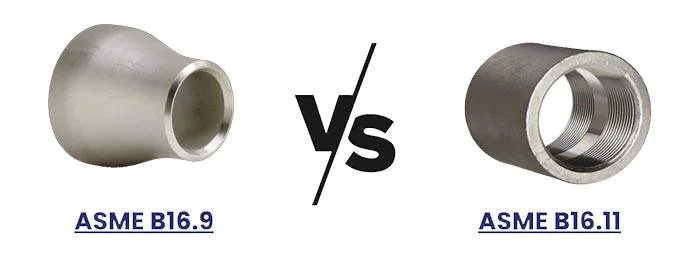
ASME B16.11 and ASME B16.9 are both widely used standards for pipe fittings, but they apply to different fitting types, connection methods, and application environments. Understanding the differences helps engineers select the appropriate standard for a given piping system.
| Feature | ASME B16.11 (Socket-Weld and Threaded Fittings) | ASME B16.9 (Butt-Weld Fittings) |
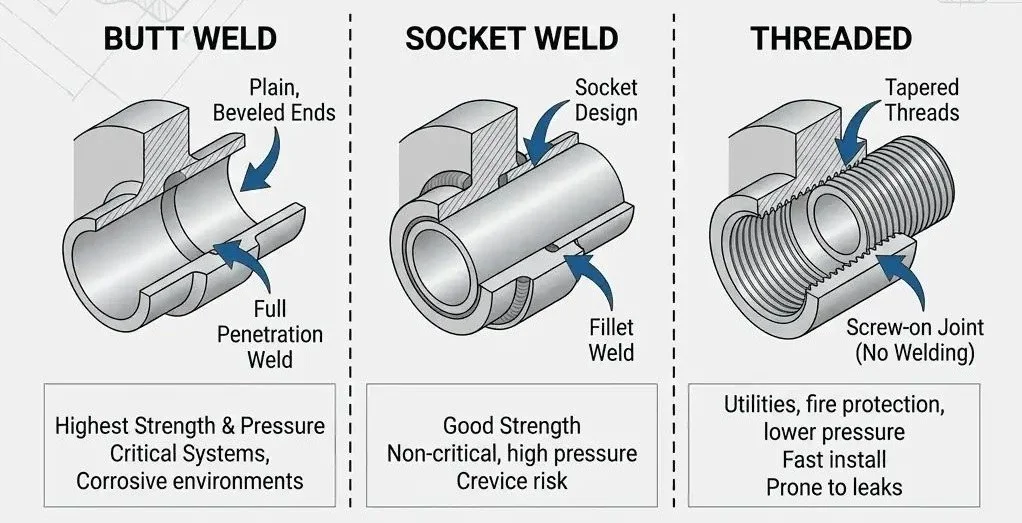
| Connection type | Threaded or socket-weld connection (mechanical or semi-permanent) | Butt-weld connection (permanent welded joint) |
| Pressure capability | Medium to relatively high pressure (Threaded: Class 2000/3000/6000; SW: Class 3000/6000/9000) | Designed for high-pressure piping systems |
| Size range | NPS 1/8 to NPS 4 (small-diameter piping) | NPS 1/2 to NPS 48 (medium and large diameters) |
| Manufacturing process | Forging and precision machining | Hot forming and heat treatment processes |
| Typical applications | Chemical plants, food processing facilities, and compact industrial systems | Oil and gas pipelines, power generation, and high-temperature or high-pressure environments |
| Installation characteristics | Easier installation and removal, suitable for systems requiring frequent maintenance | Fully welded connections, suitable for long-term, high-strength piping systems |
Selecting the appropriate standard depends on the piping size, pressure level, and installation requirements. In general, ASME B16.11 fittings are preferred for small-diameter piping systems, while ASME B16.9 fittings are used in larger pipelines where butt-weld connections provide greater structural strength and leak resistance.
14.0What Are the Key Considerations When Using ASME B16.11 Fittings?
When applying ASME B16.11 forged fittings in piping systems, several practical details must be considered to ensure safe installation and reliable operation. Understanding the characteristics of threaded and socket-weld fittings, along with proper installation practices, helps avoid common operational problems.
14.1Threaded Fitting Application Considerations
- Thread standard: ASME B16.11 threaded fittings typically use NPT threads in accordance with ASME B1.20.1.
- Applicable pipe size: Commonly used in piping systems DN 100 and smaller.
- Typical applications: Domestic water systems, fire protection piping, and industrial cooling systems where operating conditions are moderate and installation cost is relatively low.
- Installation requirement: Proper sealing using PTFE tape or thread sealant is essential to prevent leakage at threaded joints.
14.2Socket-Weld Fitting Application Considerations
- Connection type: Socket-weld fittings use fillet welds to connect the pipe to the fitting socket.
- Typical pipe size: Most commonly applied to piping systems with diameters of 2 inches or smaller.
- Typical applications: Systems transporting hazardous, flammable, toxic, or expensive fluids where leakage must be minimized, as well as steam service in the range of approximately 300 to 600 PSI.
- Advantages: No pipe end preparation such as beveling is required, which simplifies installation and reduces fabrication costs.
- Design limitation: A small expansion gap (approximately 1.6 mm) must be maintained between the pipe end and the bottom of the socket to accommodate thermal expansion during welding.
14.3Processing and Installation Considerations
- Machining accuracy: Pipe and fitting preparation should maintain dimensional accuracy within the tolerances specified by the standard. For small-diameter pipes used with ASME B16.11 fittings, precise cutting with a circular saw pipe cutting machine helps ensure consistent end preparation, proper socket fit, and compliance with dimensional requirements.
- Installation verification: The pressure class, size, and connection type of the fitting must match the corresponding pipe specifications.
- Standard compatibility: Fittings from different standards or pressure classes should not be mixed within the same system to avoid installation problems or potential safety risks.
14.4Brief History of the ASME B16.11 Standard
The development of the ASME B16.11 standard dates back to the 1940s when socket-weld fittings were first standardized for industrial piping applications. The standard was officially approved in 1946 and later expanded to include threaded fittings.
Over time, several revisions have been issued to update pressure classifications, material specifications, dimensional requirements, and metric references. Modern editions of the standard incorporate additional forged materials and refined tolerance requirements to align with current industrial practices.
15.0ASME B16.11 Standard PDF Resources Download
16.0Frequently Asked Questions About ASME B16.11
The following FAQ section summarizes common questions encountered when applying the ASME B16.11 standard in piping design and installation.
Q: What is the nominal size range covered by ASME B16.11?
A: The standard primarily covers forged fittings for piping systems ranging from NPS 1/8 to NPS 4 (DN 6 to DN 100). Larger diameter fittings are typically governed by other standards.
Q: Do threaded and socket-weld fittings have different pressure classes?
A: Yes. Threaded fittings are available in Class 2000, 3000, and 6000, while socket-weld fittings are available in Class 3000, 6000, and 9000. Threaded fittings are generally used for moderate-pressure applications, while socket-weld fittings are preferred when higher pressure capability and improved sealing performance are required.
Q: Are there machining accuracy requirements when preparing pipes for ASME B16.11 fittings?
A: Yes. Pipe ends must be prepared with sufficient dimensional accuracy to ensure that the finished assembly meets the tolerance requirements defined in the standard and allows proper alignment during installation.
Q: Can ASME B16.11 fittings be manufactured from bar stock?
A: Some fittings may be produced from bar stock; however, elbows, tees, and crosses are not permitted to be manufactured from bar stock according to the standard.
Q: How can you determine whether the fitting marking complies with the standard?
A: A compliant marking typically includes five key elements: manufacturer identification, material designation, product compliance identification, pressure class, and nominal pipe size. If the fitting size limits available marking space, certain items may be omitted according to the omission rules defined in the standard.
Q: Can ASME B16.11 fittings be used interchangeably with ASME B16.9 fittings?
A: In general, they should not be mixed. The two standards differ significantly in connection method, pressure capability, and size range. Using fittings from different standards within the same system may lead to compatibility and safety issues.
17.0Summary
ASME B16.11 is the primary standard governing forged fittings used in small-diameter piping systems. It defines essential requirements for dimensions, pressure classifications, materials, tolerances, and marking practices.
Understanding these key provisions helps engineers and technicians correctly select and apply fittings in industrial piping systems. By following the dimensional requirements, verifying marking compliance, and ensuring proper installation practices, piping systems can achieve reliable performance and long-term operational safety.
Reference
redfluid.es/en/what-is-asme-b16-11/
ssmalloys.com/asme-b16-11/
www.pipingpipeline.com/asme-b16-11-couplet-sw-thd.html